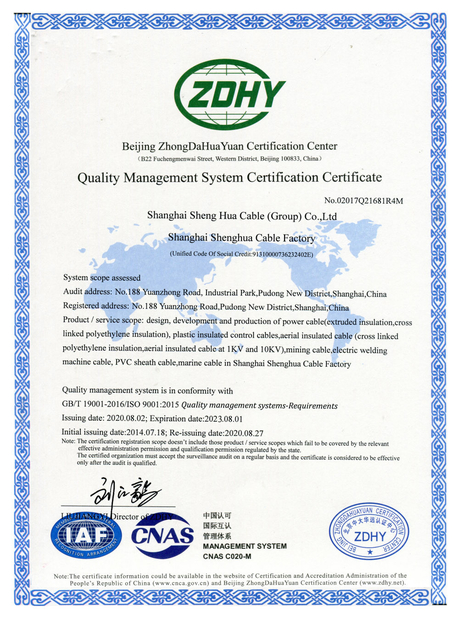
Shanghai Shenghua Cable (Group) Co, Ltd

Panduan Praktis oleh Shenghua Cable
Memilih luas penampang kabel yang tepat sangat penting untuk keselamatan kelistrikan, efisiensi, dan efektivitas biaya. Meskipun banyak insinyur mengandalkan pengalaman atau rumus yang disederhanakan, pendekatan ilmiah memastikan keandalan jangka panjang dan kinerja optimal. Berdasarkan pengalaman puluhan tahun,Shenghua Cable (Shanghai Shenghua Cable Technology Group Co., Ltd.)mempersembahkan empat metode praktis untuk menentukan penampang kabel yang benar untuk berbagai aplikasi.
Temukan rangkaian produk lengkap Shenghua Cable di sini:https://www.shanpowercable.com/
Metode yang paling mudah adalah memastikan bahwa kabel tidak melebihi suhu operasi jangka panjangnya di bawah beban normal.
Kabel berisolasi PVC: 70°C
Kabel berisolasi XLPE: 90°C
Contoh:
Kapasitas transformator: 2500 kVA
Tegangan suplai: 10 kV
Jenis kabel: XLPE, dipasang di jembatan kabel
Langkah 1: Hitung arus pengenal
I=250010.5*1.732≈137AI = frac{2500}{10.5 times 1.732} approx 137A
Langkah 2: Periksa manual kabel
YJV-8.7/10KV-3X25 → 120A
YJV-8.7/10KV-3X35 → 140A
Langkah 3: Pilih kabel
YJV-8.7/10KV-3X35 memenuhi 137A
Catatan: Metode ini tidak memperhitungkan penurunan tegangan atau stabilitas termal hubung singkat.
Metode ini menyeimbangkan biaya material dan kerugian daya. Kabel yang lebih kecil mengurangi investasi tetapi meningkatkan kerugian; kabel yang lebih besar mengurangi kerugian tetapi meningkatkan biaya. Ukuran optimal ditentukan menggunakan kepadatan arus ekonomis (A/mm²) berdasarkan jam operasi peralatan.
Contoh:
Arus pengenal peralatan: 150A
Jam operasi tahunan: 8000 jam
Kepadatan arus ekonomis: 1.75 A/mm²
S=Ieconomic density=1501.75≈85.7 mm²S = frac{I}{text{economic density}} = frac{150}{1.75} approx 85.7 text{ mm²}
Langkah 2: Pilih ukuran standar terdekat → 95 mm²
Metode ini memastikan keselamatan dan efektivitas biaya.
Untuk jalur kabel yang panjang, penurunan tegangan menjadi signifikan dan dapat memengaruhi operasi peralatan. Penurunan yang diizinkan seringkali 7% untuk jalur 400V.
Rumus penurunan tegangan:
S=I⋅ρ⋅LΔUS = frac{Icdot rho cdot L}{Delta U}
III = arus pengenal
ρrhoρ = resistivitas konduktor
LLL = panjang kabel
ΔUDelta UΔU = penurunan tegangan yang diizinkan
Contoh:
Tegangan perangkat: 380V
Arus pengenal: 150A
Resistivitas kabel tembaga: 0.0175 Ω·mm²/m
Panjang kabel: 600 m
Penurunan tegangan yang diizinkan: 26.6V
S=150*0.0175*60026.6≈59.2 mm²S = frac{150 times 0.0175 times 600}{26.6} approx 59.2 text{ mm²}
Langkah 2: Pilih ukuran standar terdekat → 70 mm²
Ini memastikan stabilitas tegangan di sepanjang jalur kabel yang panjang.
Untuk kabel tegangan menengah dan tinggi (≥6 kV), pemilihan penampang harus memperhitungkan stabilitas termal hubung singkat.
Rumus:
Smin=IdtiCS_{text{min}} = frac{I_d sqrt{t_i}}{C}
IdI_dId = arus hubung singkat
tit_iti = waktu interupsi pemutus sirkuit
CCC = koefisien termal kabel (biasanya 80)
Contoh:
Arus hubung singkat: 18 kA
Koefisien termal: 80
Waktu pemutus sirkuit: 0.25 s
Smin=18000*0.2580≈112.5 mm²S_{text{min}} = frac{18000 times sqrt{0.25}}{80} approx 112.5 text{ mm²}
Langkah 2: Pilih ukuran standar terdekat → 120 mm²
Meskipun arus pengenal kecil, kabel harus tahan terhadap tekanan hubung singkat.
Dengan menggabungkan metode pemilihan ilmiah dengan manufaktur berkualitas, Shenghua Cable memastikan:
Ukuran penampang yang akurat untuk keselamatan dan efisiensi
Kinerja termal dan listrik yang andal
Kepatuhan terhadap standar dan sertifikasi internasional
Daya tahan jangka panjang dalam sistem distribusi industri dan daya
Shenghua Cable menawarkan panduan lengkap dan dukungan teknis untuk penentuan ukuran kabel spesifik proyek.
Jelajahi portofolio produk kami:https://www.shanpowercable.com/
Memilih luas penampang kabel yang benar lebih dari sekadar mengikuti pengalaman. Dengan mempertimbangkan kapasitas arus jangka panjang, kepadatan ekonomis, penurunan tegangan, dan stabilitas termal hubung singkat, insinyur dapat memastikan instalasi yang aman, andal, dan hemat biaya.
Shenghua Cablemenggabungkan keahlian teknis dengan bahan berkualitas premium untuk menyediakan solusi yang teruji oleh waktu.