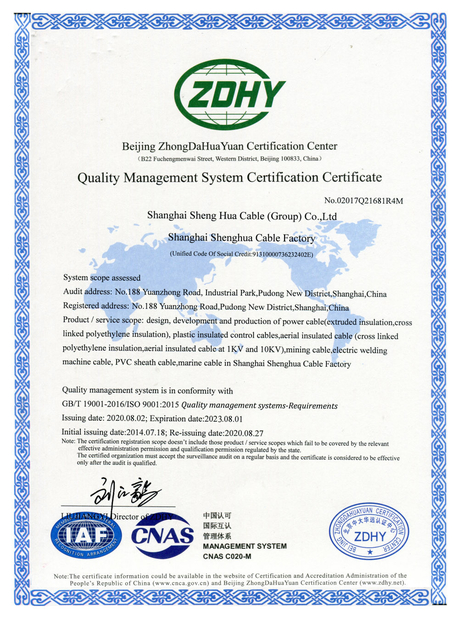
Shanghai Shenghua Cable (Group) Co, Ltd
Medium voltage covers the range from roughly 3 kV up to 35 kV, and it is the segment where cable cost per metre rises steeply and where a specification error is most expensive. A 11 kV or 33 kV cable needs field control, screened construction, careful jointing and a test regime that cannot be improvised. This guide explains what changes when a cable moves from low to medium voltage, which constructions are used, why screening and semiconductive layers become mandatory, and how to specify and qualify a supplier. Six answers follow on voltage classes, partial discharge, jointing and testing.

The first change is the electric field. At low voltage, the insulation thickness is chosen for mechanical robustness and for withstanding transients. At medium voltage, the field strength inside the insulation becomes the design driver, and the insulation thickness is calculated to keep the stress within the capability of the material.
The second change is the need for semiconductive layers. A conductor screen and an insulation screen are applied to smooth the field at the conductor surface and at the outer boundary of the insulation. Without them, the field concentrates at irregularities and at the interface with the sheath, and partial discharge begins at those points.
The third change is the metallic screen. A copper tape or wire screen over the insulation screen carries the capacitive charging current and provides a return path for fault current. It also makes the cable safe to touch at the surface by keeping the field inside.
The fourth change is the tolerance for defects. At low voltage, a small void in the insulation is unlikely to cause failure. At medium voltage, a void of a fraction of a millimetre can sustain partial discharge and erode the insulation until it fails. This is why medium voltage manufacturing requires cleanliness, dry curing and partial discharge testing of every length.
The fifth change is jointing and termination. A medium voltage joint is a field controlled assembly, made with kits that include stress cones and specific materials, and it must be made by a trained jointer in clean conditions. The accessory is often as expensive as a length of cable.
Partial discharge is a small electrical discharge that occurs in a void, at a sharp point or at an interface where the field is enhanced. It does not immediately destroy the insulation, but it erodes it slowly, and the cable fails when the remaining insulation can no longer withstand the operating voltage.
The process can take years, which makes it dangerous: a cable with a discharge problem passes the acceptance test, is installed, and fails in service long after the warranty discussion has moved on. This is why medium voltage standards require partial discharge testing on every length, usually at a level below a few picocoulombs, and why the test is performed after the routine voltage test.
For the buyer, the practical consequence is that the price of a medium voltage cable includes testing that low voltage cable does not require, and a suspiciously low price usually means the testing was reduced. The test equipment is expensive and the test takes time, so it is one of the first things a corner cutting factory removes.
The second consequence is that storage and handling matter more. A medium voltage cable that is dropped, kinked or bent below its minimum radius may develop a defect that the routine test does not detect, and the damage appears in service. Handling instructions are part of the product.
State the voltage class precisely. The notation 6/10 kV, 8.7/15 kV, 12/20 kV and 18/30 kV describes the phase to earth and phase to phase voltages, and using the wrong class is a common and expensive error. Then state the insulation, the screen and the sheath construction.
Require partial discharge and routine voltage testing, and ask for the test records. A serious supplier will state the test voltage, the duration, the discharge limit and the results per drum. A supplier who cannot describe the test regime is not a medium voltage supplier.
Specify the screen construction and the sheath. Copper wire screen with a copper tape, or a lead sheath in older designs, changes the fault current capability and the weight. State the fault current and the duration so that the screen can be sized properly.
Confirm the jointing and termination accessories at the same time as the cable. The kits must match the cable construction and the supplier's dimensional data, and mixing brands is a common source of failure. Where the project requires certified jointers, confirm availability before the schedule is fixed.
Verify on delivery by checking the drum, the cable ends and the test certificates, and by confirming the bending radius and storage conditions. Products such as the AL/XLPE/PVC Unarmoured Electrical Cable 12/20KV 3 Core 300mm2 XLPE Insulated Power Cable Electric Cable and the Shanghai Shenghua Aluminum Conductor XLPE Insulation Low Smoke Zero Halogen Cable Wire show how medium voltage constructions differ from low voltage items in the same catalogue, where the screen and the semiconductive layers add significant cost.
The metallic screen of a medium voltage cable carries the charging current in normal operation and the fault current during a short circuit. Its cross section is chosen from the fault current and the clearing time, using the same adiabatic logic as for a protective conductor, and the result is often a copper wire screen of substantial size.
The screen also affects the cable's behaviour under earth fault conditions. In a system with a solidly earthed neutral, the fault current can be large and the screen must survive it without damage. In a system with a resistance earthed neutral, the current is limited and the screen can be smaller. The specification must state which system applies, because the difference in screen size and cost is significant.
Screen bonding is a related design decision. Single point bonding limits circulating currents in long runs but requires voltage limiting devices at the unbonded end; cross bonding is used on very long routes. These are design decisions made by the network engineer, but they determine which accessories the cable supplier must provide.
Medium voltage acceptance testing typically includes a routine voltage test at a higher multiple of the rated voltage, partial discharge measurement, and a check of the screen continuity and the conductor resistance. The values are recorded per drum and supplied with the cable.
On site, after jointing, a further test is performed, often a very low frequency test or a damped alternating current test, because a direct voltage test on aged insulation is no longer favoured. The purpose is to detect defects introduced during installation and jointing, and the result is compared with the factory values.
For the buyer, the important discipline is to keep the factory records and the site records together. When a fault occurs years later, the comparison between the two shows whether the problem originated in manufacture or in installation, and that distinction determines who bears the cost of the repair.
Medium voltage cable has a larger minimum bending radius than low voltage cable of the same size, and the radius increases with voltage class and with the screen construction. Exceeding it can damage the semiconductive layers and the screen, and the damage may not appear in a routine test.
Drums should be stored upright, with the ends sealed, and the cable should be pulled with a proper grip that does not crush the sheath. Rollers at changes of direction reduce sidewall pressure, and the pulling tension should be monitored rather than estimated. A cable that is dragged over rough ground will have sheath damage that admits water, and the resulting failure may take years to appear.
After installation, the cable ends should be sealed until the jointing is done, and the jointing should follow the accessory manufacturer's instructions exactly. For medium voltage work, the accessory instructions are not guidance but requirements, and deviating from them invalidates the performance claims of both the cable and the joint.
Five items define a medium voltage order: voltage class, screen construction and fault rating, insulation type, test regime and jointing accessories. Each must be stated, and each must be confirmed in writing.
Where the network uses resistance earthing, state it, because the screen size and the cost depend on the fault current the system can deliver.
A medium voltage supplier should be able to show the test equipment, the partial discharge laboratory and the records for recent production. A visit, or a video walk through the test area, is more informative than any brochure. Where the order is large, a witnessed test is a reasonable condition and most serious factories will accept it.
The supplier should also be able to describe the handling instructions and the accessory range, because a medium voltage cable supplied without compatible joints and terminations is only half a product. A factory that makes or supplies the accessories is easier to work with than one that refers the buyer elsewhere.
Finally, ask about experience in the voltage class and the application. A supplier who has supplied 11 kV distribution cable for years will anticipate questions that a newcomer will not, and that experience shows in the documentation and in the handling advice.
Broadly from 3 kV to 35 kV. Common distribution classes are 6/10 kV, 8.7/15 kV, 12/20 kV and 18/30 kV.
It smooths the electric field at the conductor and insulation surfaces, preventing local stress concentration and partial discharge.
A test that measures small discharges inside the insulation. It is required on every medium voltage length and is the main defence against slow insulation failure.
Yes, with the correct kit and a trained jointer working in clean conditions. The joint is a field controlled assembly, not a simple connection.
Thicker insulation, semiconductive layers, metallic screen, and mandatory partial discharge testing. The testing alone is a significant share of the cost.
The insulation and screen can be damaged in a way the routine test does not detect. Respect the minimum bending radius at all times.
Medium voltage cable is defined by field control, screening and partial discharge testing, and every one of those must be specified and verified rather than assumed. State the voltage class, the screen construction and the test regime, confirm the accessories and the jointing competence, and handle the cable as a precision product. Shanghai Shenghua Cable Group produces medium voltage cable from 6/10 kV to 18/30 kV with semiconductive layers, copper screens and partial discharge testing on every length, and it supplies matched jointing and termination kits. Send your network data through our contact page and our engineers will confirm the construction and test regime. Related items include the Shenghua Group Power Cable NYY NYCY Electrical Fire Resistant Cable For Buidings / House Wiring, the 4 Core 0.6/1kV Copper PVC Power Cable IEC Certified, the Waterproof Moisture Resistant PVC Insulated Cable 0.6/1kV 2 Core 2x4mm2 Outdoor Wet Area Use, the Compact XLPE Insulated PVC Sheathed Cable Outer Semi - Conductive Layer, the 0.6/1kV Aerial Bundled Cable for Power Distribution | ABC and the Armored XLPE Insulated Power Cable Aluminum Conductor Fire Resistant.
Experience in the voltage class shows in the questions asked and in the documents supplied before they are requested.
Choosing a supplier who can answer those questions shortens the approval process and reduces the risk of a technical surprise after the drums arrive.
The test records, the handling notes and the accessory data are the evidence that a medium voltage order was properly executed.
Buyers who ask for all three at quotation stage separate serious suppliers from catalogue sellers quickly.